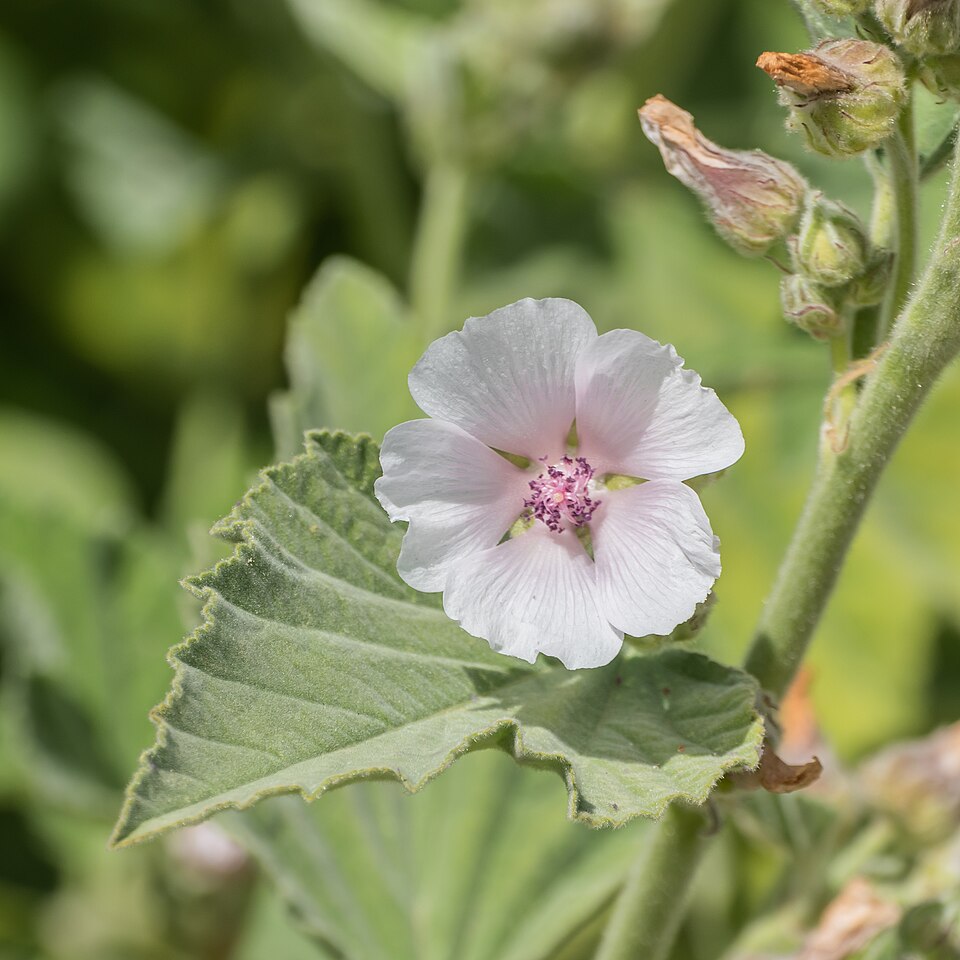
Qu'est-ce que Marshmallow Root ?
Marshmallow is a soft, grey-green member of the mallow family that grows in salt marshes and damp meadows across Europe and western Asia. Its roots are packed with mucilage — a gel-forming fibre that turns slick and soothing in water. Greek and Roman physicians used it for coughs and sore throats, and 19th-century French confectioners whipped the root sap with sugar and egg white into the first marshmallow sweets (modern ones contain none).
Marshmallow works mainly as a demulcent: the mucilage coats irritated mucous membranes and forms a protective film. European regulators recognise it as a traditional remedy for dry cough, throat irritation and mild stomach discomfort. Clinical trials are few and small, but the mechanism is plausible and its safety record is good.
Bienfaits et usages
Soothes a dry, irritating cough
The best-established use. Marshmallow syrups and lozenges are standard European remedies for dry, tickly coughs; small studies suggest they ease irritation, largely by coating the throat and calming the cough reflex.
Calms a sore throat
The mucilage forms a soothing layer over inflamed tissue. Gargling or sipping a cold infusion is a traditional, gentle approach.
Mild stomach irritation
A traditional remedy for heartburn-type discomfort and irritated stomach lining; the coating effect is thought to extend into the gut. Human evidence is thin.
Skin and minor inflammation
Used traditionally as a poultice or ointment for dry, irritated skin. Lab studies show mild anti-inflammatory activity, but clinical evidence is limited.
Comment l'utiliser
Cold infusion
The classic method, because heat extracts starch as well as mucilage. Soak 1–2 tsp chopped dried root in a cup of cold water for 30 minutes to a few hours, stirring occasionally, then strain. Warm it gently if you like. Up to 3 cups daily.
Syrup
Ready-made marshmallow syrups are widely sold for coughs; follow the label. Note that most contain a lot of sugar.
Lozenges
Sucked slowly, they keep a coating on a raw throat for longer than a drink. Useful at night.
Leaf and flower tea
The leaves contain less mucilage but make a milder hot tea: 1–2 tsp dried leaf per cup, steeped 10 minutes.
Gargle
Use a cooled cold infusion as a gargle several times a day for a sore throat.
⚠️ Précautions
- Other medicines: the mucilage can slow or reduce absorption of medicines taken at the same time. Take any tablets at least an hour before, or a couple of hours after, marshmallow.
- Diabetes: animal studies suggest it might lower blood sugar slightly. If you take diabetes medication, monitor your levels when starting it.
- Pregnancy and breastfeeding: there is little safety data. Occasional tea is generally considered low-risk, but avoid concentrated extracts without medical advice.
- Allergy is rare, but avoid it if you react to mallow-family plants.
- A cough lasting more than three weeks, or with fever, breathlessness or blood, needs a doctor rather than a herbal remedy.
Ceci est une information générale, pas un avis médical. Consultez un professionnel de santé avant d'utiliser Marshmallow Root pour traiter un trouble ou en association avec des médicaments.
Questions fréquentes
Do marshmallow sweets have any of the root in them?
No. Modern marshmallows are made from sugar and gelatin or starch; they only borrowed the name.
Why cold water?
Cold soaking pulls out the mucilage while leaving most of the starch behind, giving a smoother, more effective drink. Boiling gives a cloudier, starchier result.
Is it the same as slippery elm?
Different plants, similar idea: both are rich in soothing mucilage. Marshmallow is cultivated easily and has no sustainability problem, so it is a good alternative to slippery elm.
Commentaires