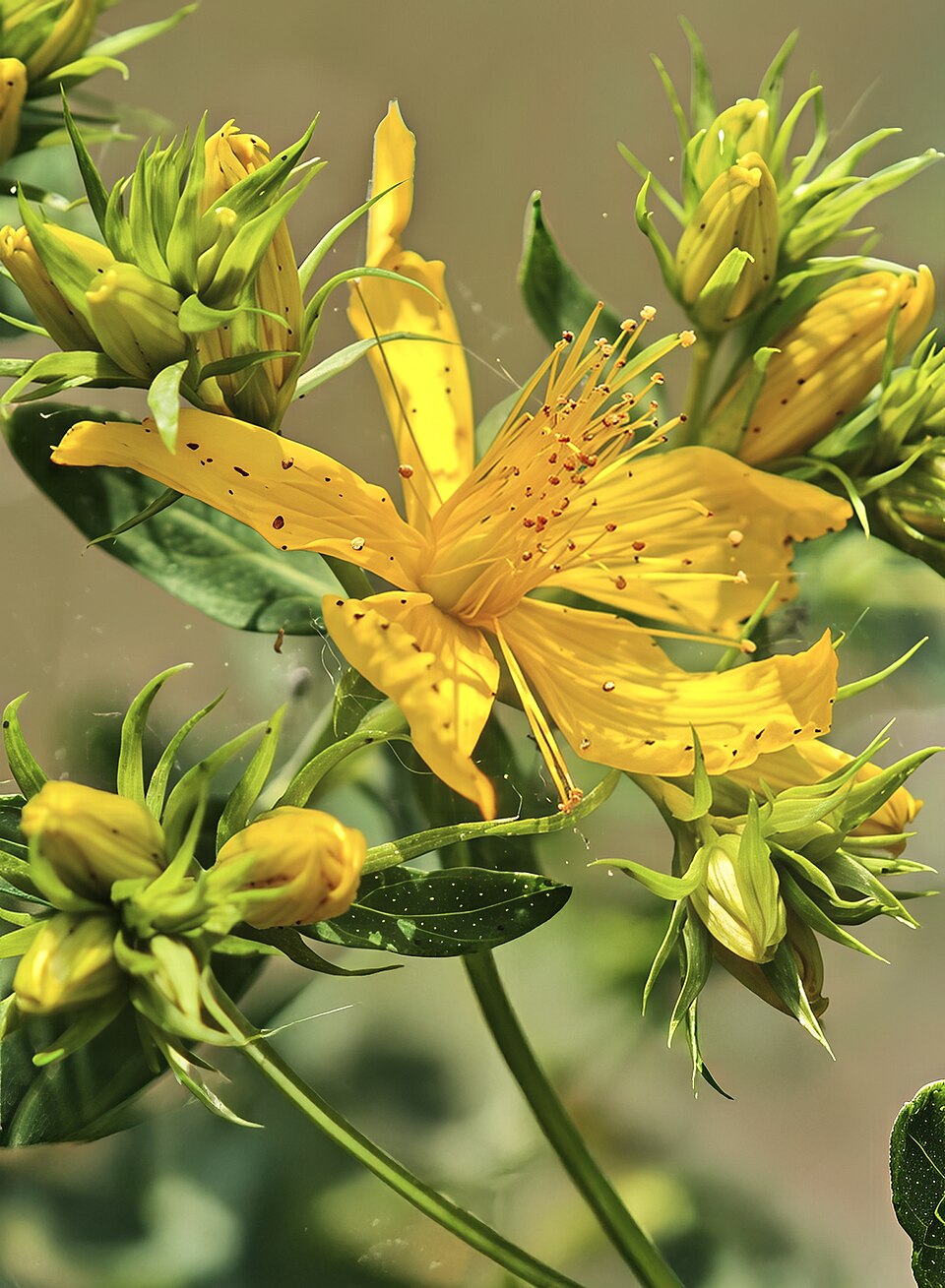
Was ist St John's Wort?
St John's wort is a yellow-flowered meadow herb that blooms around St John's Day (24 June). Hold a leaf to the light and you will see tiny translucent dots — hence perforatum — and crush a flower bud and your fingers turn red from hypericin. It was hung over doorways to ward off evil spirits, and the red oil made by steeping the flowers has been a wound remedy since the Middle Ages. Its key compounds are hyperforin and hypericin.
For mild to moderate depression, the evidence is genuinely strong for a herb: many placebo-controlled trials and several meta-analyses found standardised extracts worked better than placebo and roughly as well as standard antidepressants, with fewer side effects. The catch is serious: it speeds up the breakdown of a long list of medicines, making them less effective, and it can cause a dangerous reaction when combined with other antidepressants. Never start it without checking every medicine you take.
Wirkung & Anwendungsgebiete
Mild to moderate depression
The best-studied use. Meta-analyses of placebo-controlled trials found standardised extracts (usually 900 mg daily) improved symptoms of mild to moderate depression about as well as common prescription antidepressants. It is not suitable for severe depression, and depression should always be diagnosed and followed up by a doctor.
Low mood with the seasons
Small studies suggest it may help seasonal low mood, sometimes alongside light therapy. The evidence here is thin compared with its main use.
Menopausal mood symptoms
A few trials, often combining it with black cohosh, reported improvements in mood-related menopausal symptoms. Promising, but it brings the same interaction problems.
Wounds and minor burns (topical)
Traditionally the red infused oil is applied to bruises, minor burns and small wounds. Lab studies show antibacterial and anti-inflammatory activity; human evidence is limited to small studies.
So wendest du sie an
Standardised extract
The form used in trials: typically 300 mg three times daily (900 mg total), standardised to hypericin and/or hyperforin. Effects take 2–4 weeks to appear, like prescription antidepressants. Only after you have cleared it with a doctor or pharmacist.
Tea
1–2 tsp dried flowering tops per cup, covered, 5–10 minutes. Tea strength is unpredictable, so it is a gentle traditional use rather than a reliable treatment — and it carries the same interaction risks.
Infused oil (red oil)
Fill a jar with fresh flowers, cover with olive oil and leave in a sunny spot for 4–6 weeks until deep red; strain. Apply to bruises or small closed wounds. Avoid sun on treated skin.
Stopping safely
If you have been taking it daily, taper off over a week or two rather than stopping abruptly, and tell your doctor — stopping it can make interacting drugs suddenly stronger.
⚠️ Vorsichtshinweise
- Interactions are the number-one safety issue. It makes many medicines less effective, including the contraceptive pill (risk of unplanned pregnancy), warfarin and other blood thinners, digoxin, ciclosporin and tacrolimus (transplant rejection risk), HIV drugs, some cancer drugs, statins, some epilepsy drugs and more. Always check with a pharmacist first.
- Never combine with SSRIs, SNRIs, MAOIs, triptans, tramadol or other serotonin-boosting drugs — the combination can cause serotonin syndrome (agitation, fever, rapid heartbeat), which can be dangerous.
- Avoid in pregnancy and breastfeeding; safety is not established.
- Not suitable for bipolar disorder (it can trigger mania) or severe depression, and not a substitute for medical care if you have thoughts of self-harm — seek help immediately.
- Causes sun sensitivity in some people, especially at high doses or fair-skinned users; use sun protection and avoid it with light therapy or photosensitising drugs unless supervised.
- Stop at least two weeks before surgery, as it interacts with anaesthetics and many hospital drugs. Common side effects include stomach upset, dizziness, dry mouth and restlessness.
Dies sind allgemeine Informationen, keine medizinische Beratung. Sprich mit medizinischem Fachpersonal, bevor du St John's Wort zur Behandlung einer Erkrankung oder zusammen mit Medikamenten verwendest.
Häufige Fragen
Does the tea interact with medicines too?
Yes. Hyperforin, the main culprit behind interactions, is present in teas and tinctures as well as capsules. Treat any form as a potential interaction.
Can I switch from my antidepressant to St John's wort?
Only under your doctor's supervision. Stopping an antidepressant suddenly causes withdrawal effects, and overlapping the two can cause serotonin syndrome — a careful, planned switch is essential.
Why is it so well studied?
Because in Germany it has long been prescribed for mild depression, which funded large clinical trials. That gives it a stronger evidence base than most herbs — and a much clearer picture of its risks.
Kommentare