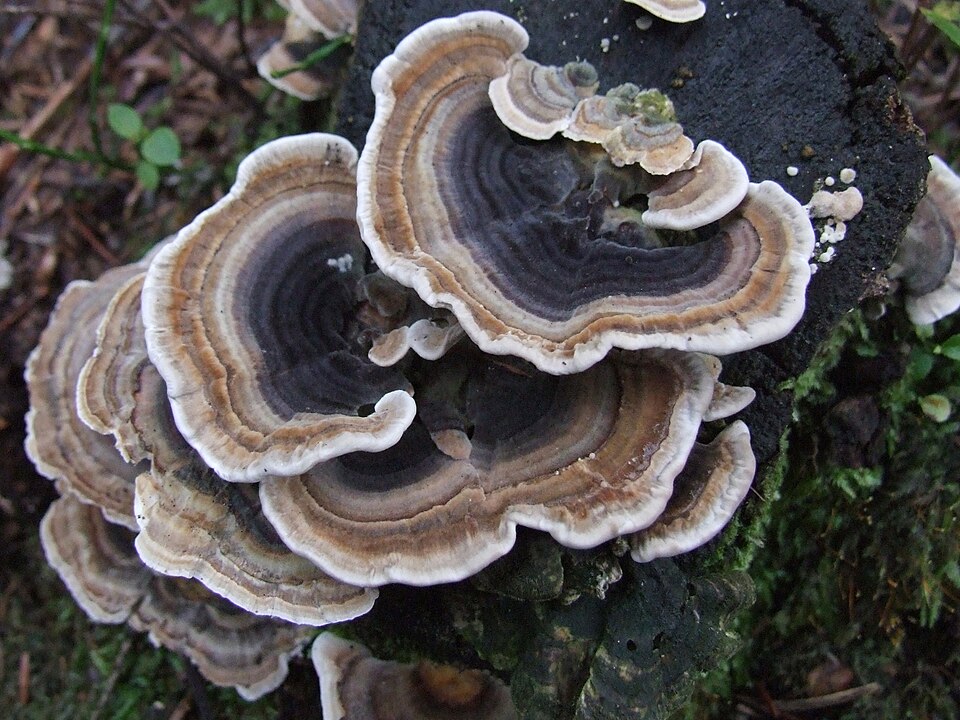
Was ist Turkey Tail?
Turkey tail is a fungus, not a plant: thin, leathery, fan-shaped brackets that grow in overlapping tiers on dead hardwood, banded in browns, greys and blues like a strutting turkey's tail. It is one of the most common fungi on earth, too tough to eat, and has been brewed as a tea in Chinese and Japanese traditional medicine for centuries. Its best-known compounds are protein-bound polysaccharides called PSK and PSP.
Turkey tail is mainly of interest for how it affects the immune system. In Japan, a purified, prescription extract called PSK has been used by doctors alongside standard cancer care, and studied in that setting for decades. That is a specific medicine given under specialist supervision — it does not mean turkey tail supplements treat cancer, and they should never be used instead of medical treatment. For general wellbeing, evidence in healthy people is limited to small studies on immune markers and gut bacteria.
Wirkung & Anwendungsgebiete
Immune-modulating polysaccharides
Turkey tail beta-glucans and polysaccharide-peptides activate immune cells in the lab and changed immune markers in some small human studies. Whether this prevents infections in healthy people is unknown.
Possible prebiotic effect
A small human study found turkey tail extract shifted gut bacteria in a favourable direction, acting like a prebiotic fibre. It is an interesting early result.
Studied alongside medical care — not a treatment
Purified PSK and PSP have been researched as add-ons to conventional cancer care in Japan and China, under specialists. These are prescription-grade products, and none of this research supports treating any illness with turkey tail supplements on your own.
Antioxidant compounds
Turkey tail contains phenolic and flavonoid antioxidants in lab tests. As with most antioxidant claims, benefits in people have not been demonstrated.
So wendest du sie an
Tea or decoction
Simmer 1–2 tbsp of dried, chopped turkey tail in 500 ml of water for 45–60 minutes, then strain. Mild, earthy and slightly bitter; 1–2 cups daily.
Extract capsules
Choose a hot-water extract made from the fruiting body, with stated beta-glucan content. Follow the label, commonly 1–3 g daily.
Powder in food
Hot-water extract powder can be stirred into soups, broths or drinks. Raw ground mushroom is hard to digest, so extracts are preferable.
Foraging with care
Turkey tail is common but has lookalikes (such as false turkey tail, Stereum). True turkey tail has tiny pores underneath, not a smooth surface. If unsure, buy it.
⚠️ Vorsichtshinweise
- Cancer: turkey tail is not a cancer treatment. If you have cancer, talk to your oncology team before taking it, as supplements can interact with chemotherapy and other treatments.
- Immune conditions: because it may stimulate immunity, avoid it if you have an autoimmune disease or take immunosuppressants, such as after an organ transplant, unless your doctor agrees.
- Pregnancy and breastfeeding: avoid — there is not enough safety data.
- Side effects are usually mild: bloating, gas, diarrhoea or darkened stools. Some people taking PSK have reported darkened nails.
- Avoid if you are allergic to mushrooms or moulds, and stop if you notice rash, itching or breathing difficulty.
Dies sind allgemeine Informationen, keine medizinische Beratung. Sprich mit medizinischem Fachpersonal, bevor du Turkey Tail zur Behandlung einer Erkrankung oder zusammen mit Medikamenten verwendest.
Häufige Fragen
Can turkey tail cure cancer?
No. A purified extract has been used by doctors in Japan as an add-on to standard cancer treatment, but supplements do not treat cancer. Never replace or delay medical treatment with turkey tail.
Is turkey tail edible?
It is not poisonous, but it is far too tough and leathery to eat. It is used as a tea or extract.
Is it safe for everyday use?
For most healthy adults, normal doses appear well tolerated in short-term studies. Long-term safety has not been studied, so it is sensible to take breaks.
Kommentare