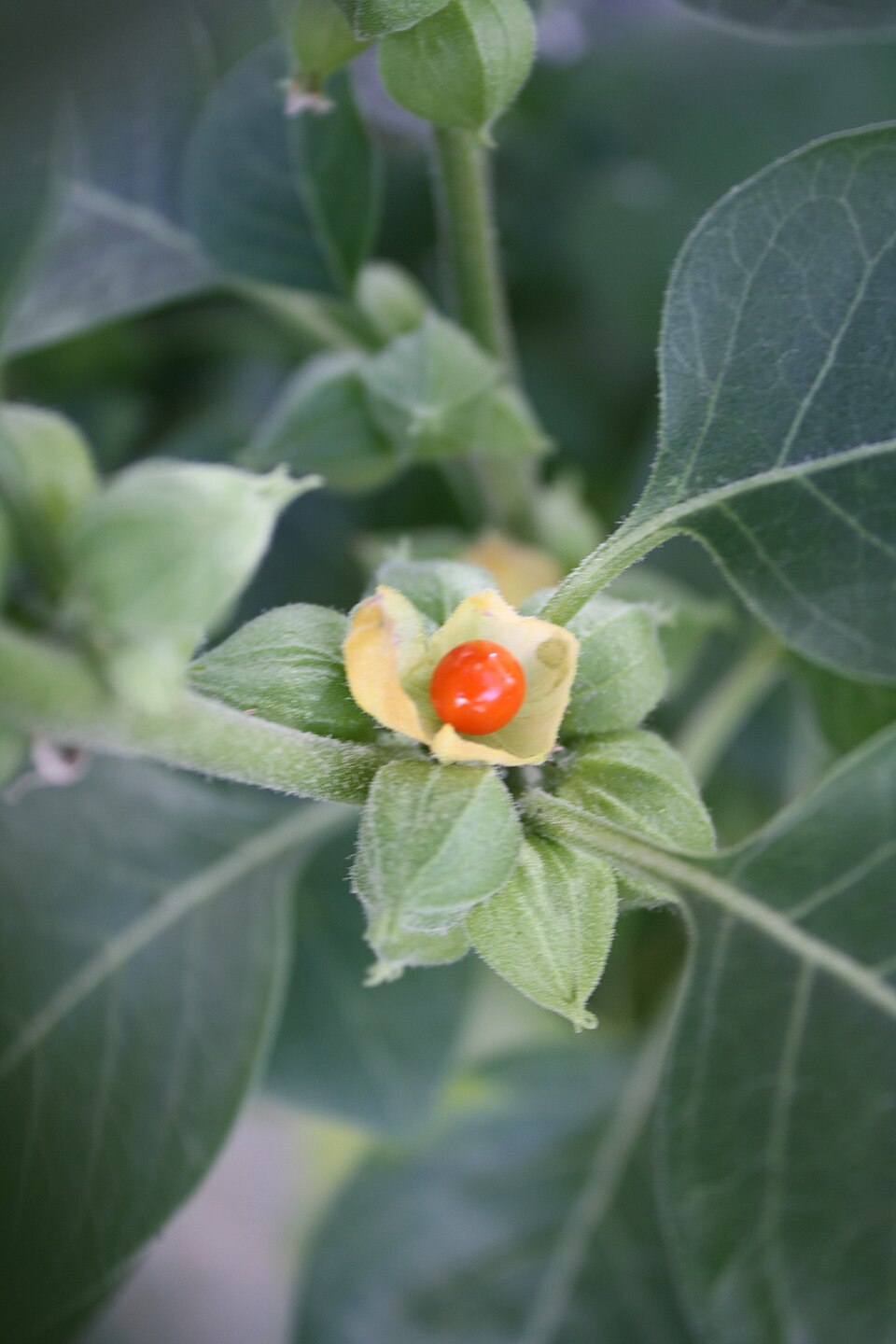
¿Qué es Ashwagandha?
Ashwagandha is a nightshade-family shrub whose root has anchored Ayurvedic medicine for some 3,000 years as a rasayana — a rejuvenating tonic. The Sanskrit name means "smell of the horse," referring to the root's odour and, tradition says, the strength it confers. Its active constituents, withanolides, are steroidal compounds unique to the plant.
It has become the flagship "adaptogen" of modern supplement culture, and unusually for that category it has accumulated a respectable stack of randomised trials: standardised root extracts repeatedly reduced perceived stress and cortisol levels versus placebo, with secondary evidence for sleep and modest effects on strength and testosterone in men.
Beneficios y usos
Reduces stress and anxiety
The headline effect: in multiple placebo-controlled trials, 240–600 mg/day of standardised root extract (e.g., KSM-66, Sensoril) significantly lowered perceived-stress scores and morning cortisol over 6–12 weeks.
Improves sleep
Trials show faster sleep onset and better sleep quality, especially in people with insomnia — fitting its species name, somnifera, "sleep-bringing."
Supports strength and recovery
In resistance-training studies, supplemented groups gained modestly more muscle and strength than placebo, plausibly via stress-hormone effects.
May support male hormonal health
Several trials found increased testosterone and improved sperm parameters in stressed or subfertile men. Effects in women are far less studied.
Traditional vitality tonic
In Ayurveda it is given for convalescence, frailty and "unquiet mind" — uses that map surprisingly well onto the modern trial evidence.
Cómo usarla
Standardised extract
The evidence-backed route: 300 mg twice daily (or 600 mg once) of a root extract standardised for withanolides, taken with food, for at least 6–8 weeks. This is what the positive trials actually used.
Timing
For sleep, take the (second) dose in the evening; for daytime stress, morning and evening split works well. It is not acutely sedating — effects build over weeks.
Traditional powder (churna)
Ayurvedic style: ¼–½ tsp root powder simmered in warm milk with a little honey and cardamom at bedtime. Earthier taste, less precise dosing.
Cycling
Long-term continuous data beyond ~3 months is limited; a common pragmatic pattern is 8–12 weeks on, a few weeks off.
⚠️ Precauciones
- Avoid in pregnancy — traditional sources and modern guidance agree (possible uterine effects).
- Thyroid: it can raise thyroid-hormone levels; caution with hyperthyroidism or thyroid medication.
- Rare cases of liver injury reported with supplements — stop if you develop nausea, dark urine or jaundice.
- Nightshade-family plant: avoid with nightshade allergy.
- It adds to sedatives, may interact with immunosuppressants and diabetes/blood-pressure drugs.
- Autoimmune conditions: discuss with a doctor first (immune-stimulating potential).
Esta es información general, no consejo médico. Consulta a un profesional de la salud antes de usar Ashwagandha para tratar una afección o junto con medicamentos.
Preguntas frecuentes
How fast does it work?
Not like a pill — trials show separation from placebo emerging over 4–8 weeks. Commit to at least two months before judging.
KSM-66 vs Sensoril — does it matter?
Both are root extracts with positive trials; KSM-66 skews toward vitality/strength studies, Sensoril (higher withanolide %) toward stress/sleep at lower doses. Either beats an unstandardised powder of unknown potency.
Will it make me drowsy at work?
Generally no — it is calming, not sedating. A minority do report daytime sleepiness; if so, shift the full dose to evening.
Comentarios